
By Hunter Floyd | KU Center for Technology Commercialization
KU offers accessible force-sensing technology for everyday use
People make important decisions about movement every day without really knowing what their bodies are doing. When an athlete jumps, a patient takes a step during rehabilitation or an older adult works to maintain balance, the body generates a complex pattern of forces that can reveal important information about performance, recovery and long-term health.
Yet the tools used to measure how force moves through the body have traditionally been confined to specialized laboratories. A technology developed through University of Kansas research is helping change that, bringing sophisticated movement analysis into gyms, clinics and other real-world settings where people can use the information immediately.
That technology, called LaunchPad, is built on Axiocell, a smart material platform developed at KU that is changing how force and movement can be measured. Created by Cory Berkland and Jonathan Miller, the technology was commercialized through the KU Center for Technology Commercialization (KUCTC) and became the foundation for Axioforce, the KU startup they co-founded with Stephen Tungett, chief operations officer of Axioforce.
“We wanted to take force measurement out of the lab and put it into the hands of people who could use that information in the real world,” said Jonathan Miller, assistant research professor of bioengineering at KU and co-founder of Axioforce. “Traditional force sensors are remarkably capable, but they are also rigid, bulky, expensive and often confined to laboratory environments.
“As researchers, we saw an opportunity to make high-quality force measurement dramatically more accessible, both by lowering the cost and by creating sensors that could take entirely new shapes and be incorporated into products where conventional load cells simply couldn’t.”
Axiocell uses an adaptable material that is opening doors to force-sensing applications far beyond where conventional technology started.
Turning a material into a measurement tool
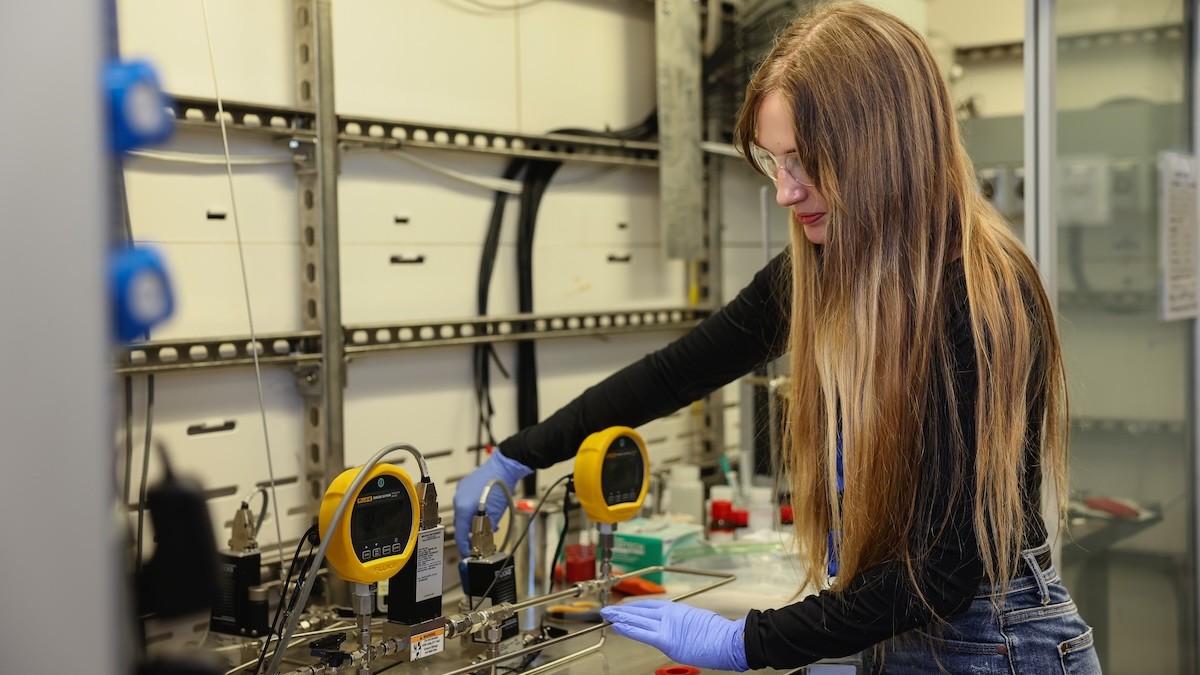
Axioforce launched its first commercial product built on the Axiocell platform, LaunchPad, in 2025. The lightweight, portable force plate measures force in multiple directions and provides immediate feedback on movement and performance. Coaches, trainers and athletes can analyze activities such as jumping, throwing and swinging without needing access to a dedicated biomechanics laboratory.
For Miller, a key breakthrough came from rethinking assumptions about how force sensors should work.
“The realization was that softness wasn’t a limitation; it could actually be an advantage,” Miller said. “That opened the door to greater sensing ranges, new geometries and applications, while also creating a sensor architecture that could ultimately be much simpler and less expensive to manufacture.”
Seeing it in action
The public impact of the technology was evident as soon as it moved beyond the laboratory and into the hands of athletes, coaches and researchers.
“The feedback that has meant the most to us has come from coaches and researchers who tell us they are now collecting data they simply couldn’t access before,” Miller said. “Traditional force plates were often too expensive to deploy in their environment, or they needed measurements in settings that didn’t accommodate bulky three-dimensional force plates.”
According to Miller, sports performance staff have reported that portable, high-quality force measurement has changed how they monitor athletes and make training decisions. Researchers have said the accessibility and affordability of the technology have enabled study designs that previously were not feasible. For Miller, watching others use the technology to answer real-world questions marked a turning point in the innovation journey.
“One of the most exciting transitions was seeing the technology move from something we were validating in a laboratory to something people were using to answer real questions,” Miller said. “Once our force plates began being used by professional sports organizations, universities and researchers, we could see that we hadn’t simply created a new sensor. We had created a tool that could make sophisticated force measurement available in environments where it had previously been difficult or too expensive to deploy.”
From bench to business
Transforming Axiocell from a university research discovery into a commercial product required more than scientific innovation. KUCTC worked to protect intellectual property, secure patent protection and help the technology become publicly accessible through an exclusive license agreement with Axioforce.
Miller said the technology stood out because it represented a fundamentally different approach to force sensing.
“Axiocell was compelling because it wasn’t simply an incremental improvement to a traditional load cell,” Miller said. “The underlying architecture allowed us to create force sensors that could be smaller, softer, digital, highly customizable and substantially less expensive than many conventional multi-axis solutions. Just as importantly, the technology could be manufactured in different shapes and configurations, giving it the potential to address applications ranging from sports and medical devices to robotics and industrial systems.”
With support from the university, Axioforce secured federal funding and established local operations at KU Innovation Park adjacent to the Lawrence campus.
“Staying at KU Innovation Park was a natural fit because the technology itself was born out of university research, and remaining close to that environment has kept us connected to the talent, equipment and collaborative culture that made the original work possible,” Miller said. “We’ve been able to draw on relationships with faculty, graduate students and university resources in ways that would be much harder to replicate in isolation.”
The company also benefits from being surrounded by other entrepreneurs, mentors and regional partners that support the local innovation ecosystem.
“Beyond the practical advantages, there’s real value in being part of a community of other early-stage companies, mentors and regional partners who are all working through similar challenges,” Miller said. “That proximity has accelerated our development in ways we didn’t fully anticipate.”
What’s next
While sports performance provided one of the first commercial applications for Axiocell, the technology’s potential extends far beyond athletics. Axioforce is exploring uses in healthcare and wellness, including gait analysis, fall prevention, rehabilitation after injury and long-term movement monitoring.
By making force-sensing technology easier for the public to access, the platform can provide meaningful movement data to clinicians, caregivers, researchers and everyday users.
“Our goal is to continue expanding what is possible with force sensing,” Miller said. “We’re already commercializing the technology in three-dimensional force plates and developing applications in robotic tactile sensing, smart medical insoles and miniature load cells — but we believe those are only the beginning. Long term, we want Axioforce technology to become an enabling platform that allows force and touch sensing to be incorporated into products across robotics, healthcare, sports, industrial automation, aerospace, defense and applications that haven’t even been conceived yet.”
Looking back, Miller said one of the most rewarding aspects of the journey has been seeing a fundamental research discovery evolve into a practical tool with broad impact.
“What’s particularly rewarding is that this began as fundamental research, not as an attempt to build a specific commercial product,” Miller said. “The discovery of a new way to measure force ultimately revealed opportunities we couldn’t have anticipated at the beginning. Axioforce is an example of what can happen when university research, engineering, entrepreneurship and industry come together to take an idea from the laboratory and put it into the real world.”
The technology caught national attention for public impact. Axiocell was featured by the Association of University Technology Managers (AUTM) — a professional association that aims to educate, promote and inspire the development of academic research — as part of its Better World Project, a collection highlighting university innovations that have made a tangible difference in people’s lives. Read the AUTM Better World Project feature on Axiocell.
“Every innovation begins with a question,” said Cliff Michaels, executive director of KUCTC. “In those early moments of discovery, the ultimate impact is often unknown, but with the right support, partnerships and persistence, those innovations can become products that drive impact. That’s what we’ve seen with Drs. Berkland and Miller and their work with Axioforce progressing from an idea to a tangible product you can pick up and touch. We’re excited to see other ways the company’s Axiocell technology can be used to improve health.”
KUCTC is proud to support technologies that have real-world, accessible impacts on the public through healthcare, wellness and other industries. Explore KU’s available technologies and see how researchers are developing innovative solutions for public benefit.
This story was originally published by the KU Office of Research here. Photo courtesy of Axioforce.